 Zenith Wellness
Heart rate during lifting is a poor primary metric. You perform a set of heavy deadlifts and your heart rate spikes for ten seconds. You rest for three minutes and it drops back to zone 1. A wearable watching your heart rate sees an easy session with occasional blips, but your legs, back, and grip are experiencing significant strain that doesn’t register.
This is the gap that Wareable identified when they wrote that gym-focused users have been “woefully unsupported in the world of wearables.” The strain of lifting is muscular, not cardiovascular. Heart rate zones were never designed to measure it.
Zenith was built to close this gap.
Intensity Zones, Not Heart Rate Zones
Heart rate zones tell you how hard your cardiovascular system is working. That’s not the right system for measuring lifting intensity. What matters is how heavy the weight is relative to what you can handle.
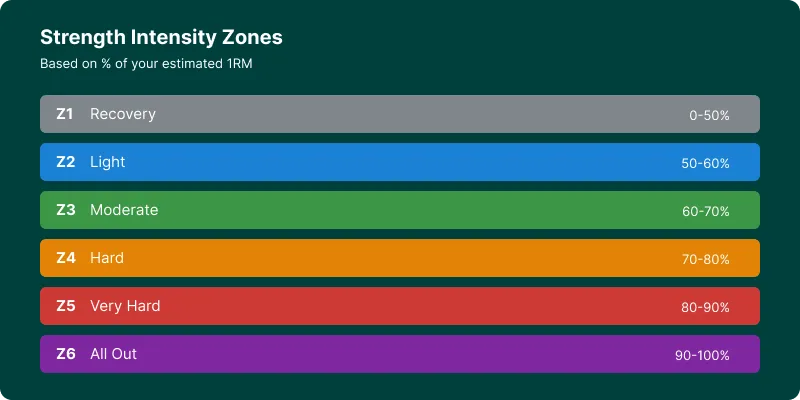
Zenith uses six intensity zones based on your estimated one-rep max (1RM) for each exercise. A warmup set at 50% of your max and a working set at 85% look completely different to your muscles. They should look completely different to your tracking, too, but heart rate might barely change between the two. Intensity zones capture the difference.
1RM Estimation
To place each set in the right intensity zone, Zenith needs to know your one-rep max. You have two options: set it manually for lifts you’ve tested, or let Zenith estimate it from your working sets.
The estimation uses two well-established formulas depending on the rep range. For sets of 2 to 8 reps, Zenith applies the Epley formula. For sets of 9 or more, it switches to the Mayhew formula. Higher-rep sets are less predictive of true max strength, so the formula adjusts accordingly.
For compound lifts like bench press, squat, deadlift, and Olympic lifts, strong performances automatically update your global percentile. More on that below.
Demographic Percentiles
A 200-pound squat means something very different for a 140-pound woman than a 220-pound man. Raw numbers without context are hard to interpret.
Zenith adjusts your 1RM using percentile tables derived from open source lifting databases, covering hundreds of exercises. The tables account for age, sex, and bodyweight to place you on a percentile curve against the general population. So instead of just knowing your bench press is 185 pounds, you know where that puts you relative to people of similar build and training background.
Muscular Strain
This is the core of how Zenith quantifies lifting. Every set you log generates a strain contribution based on which intensity zone it falls in. The relationship between zones and strain is deliberately non-linear, with higher zones contributing exponentially more.
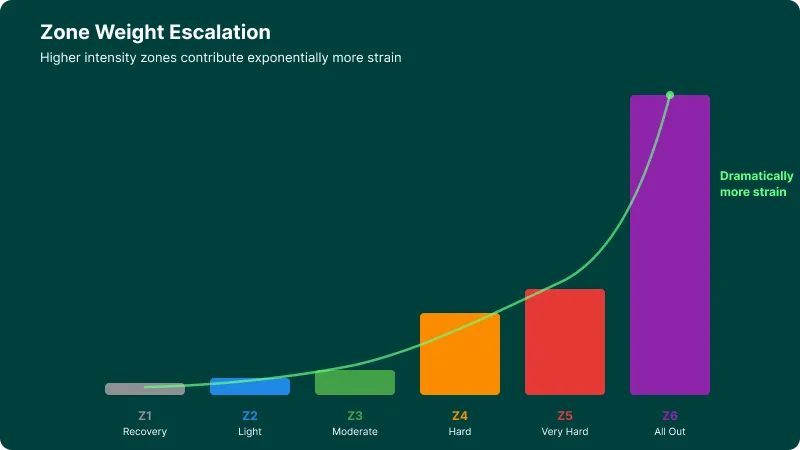
A true max-effort set taxes your central nervous system, damages far more muscle fibers, and requires significantly more recovery than a light warmup, and the weighting reflects that.
Zenith then scales the total into a single strain score that’s easy to read at a glance but still reflects the difference between a light session and a demanding one.
Muscle Activation and Heatmaps
Knowing how hard you worked is half the picture. The other half is knowing what you worked.
Zenith’s exercise library contains 400+ exercises. Every one is mapped to specific muscle groups with research-derived activation percentages across 25 distinct muscle groups.
Take the bench press as an example. Every rep distributes load across your entire body, but not evenly. The anterior deltoid takes about 24% of the total effort, mid chest takes 22%, triceps 14%, with the remaining load spread across upper chest, lower chest, biceps, core, and stabilizers. Even your quads and hip flexors contribute real effort through leg drive and arch stabilization. The activation mappings in Zenith’s library are informed by EMG research, not guesswork.
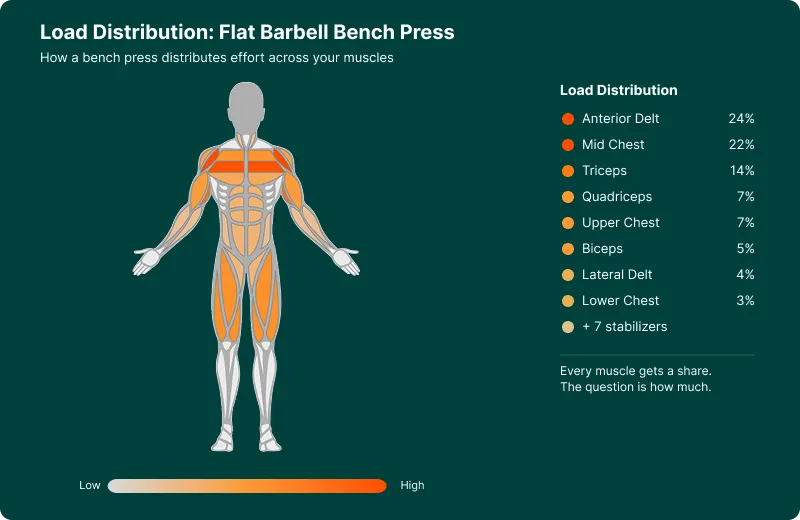
The result is an anatomical heatmap covering 25 muscles across anterior and posterior body views. After each workout, you can see exactly which muscles were activated and how intensely. Over the course of a week, patterns emerge. Maybe you’re loading your anterior delts three times but barely touching your rear delts. Maybe your quad volume is double your hamstring volume. The heatmap surfaces imbalances without requiring you to track them manually.
Unified Strain: Cardio and Lifting in One Number
If you run in the morning and lift in the afternoon, most platforms give you two separate activity summaries. Your run feeds into your training load. Your lifting sits in a silo, disconnected from recovery and readiness calculations. But both sessions tax the same body, and recovery has to account for all of it.
Zenith calculates aerobic strain from heart rate zones during cardio and muscular strain from intensity zones during lifting. Then it combines them into a single daily strain score. The combination is non-linear: your hardest activity dominates. Adding a light jog after a heavy squat session doesn’t meaningfully increase your strain. But stacking a hard run on top of a hard lift does.
This is the gap most wearables leave open. Strength data that never connects to recovery. Lifting sessions that don’t factor into readiness calculations. Zenith addresses this by treating muscular and cardiovascular strain as parts of the same system.
The Exercise Library
400+ exercises covering barbells, dumbbells, cables, machines, bodyweight movements, and more. Each one mapped to specific muscle groups with activation percentages grounded in research.
Bodyweight exercises get their own treatment. Since there’s no external load to calculate intensity from, Zenith uses rep-based percentile estimation to gauge effort. Performing 5 strict pull-ups means something different for someone who weighs 150 than someone who weighs 220, and the system accounts for that.
The library covers the exercises people actually perform in the gym, from the basics (bench, squat, deadlift, overhead press) to the specific (cable face pulls, incline dumbbell curls, hip thrusts, landmine rows).
Your Watch Already Tracks the Data
If you wear a Garmin, you’re already collecting the data. Zenith adds what your watch leaves out: strength training that feeds into the same strain and recovery system as your cardio.
Ready to make your lifting count? Try Zenith. It’s free to start.