 Zenith Wellness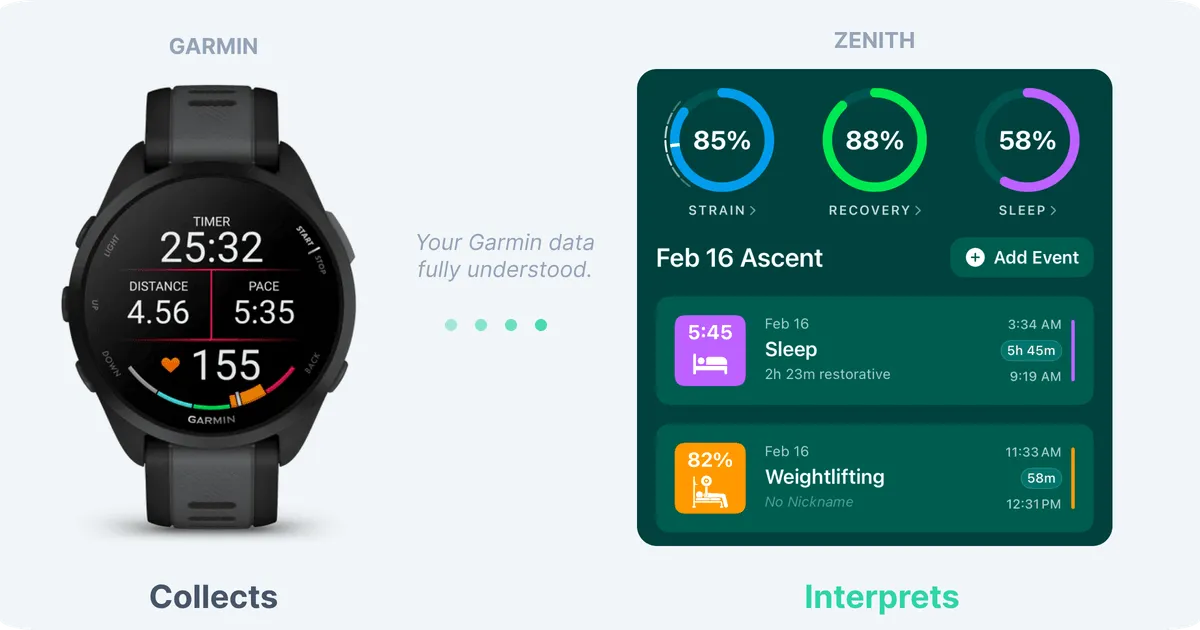
Garmin builds the best fitness ecosystem on the planet. Not just watches. Bike computers, running dynamics pods, power meters, maps with turn-by-turn navigation, sport profiles for practically everything. The GPS accuracy is unmatched. The battery seems to last forever. There’s a reason so many athletes trust Garmin with their training, and it’s not brand loyalty. It’s because the hardware is that good.
If you’re reading this, you probably already own one. Keep it. Zenith is built for Garmin users, not against them.
But Garmin is a hardware company that happens to make software. And that software has a blind spot.
The Strength Training Blind Spot
Garmin’s Training Load runs on EPOC (Excess Post-Exercise Oxygen Consumption). It measures how much oxygen your body needs to recover after aerobic effort. For running, cycling, and swimming, this works great.
It doesn’t work for strength training.
This isn’t just us being opinionated. As Wareable put it, gym-focused users have been “woefully unsupported in the world of wearables,” with tracking reduced to “a simple measure of exertion gleaned from assessing cardiovascular load.” A peer-reviewed study in PMC confirmed that consumer wearables for resistance training are “not thoroughly validated or standardized.”
Here’s what that looks like in practice. You grind out a heavy set of squats near your max. Your heart rate spikes for a few seconds during the set, then drops right back to zone 1 while you rest. Garmin sees easy effort. But your central nervous system is taxed, your muscle fibers are damaged, and you’ll be sore for three days. None of that shows up in Training Load.
So if you run 5 miles in the morning and squat heavy in the afternoon, Garmin thinks you had a moderate day. Your body knows better.
The frustrating part is that Garmin does have a Strength activity profile. Plenty of athletes use it to log their lifting. But that data just sits there. It never feeds into Training Load, Training Status, or Recovery Time. You’re doing the work of tracking it, and the system pretends it didn’t happen.
Zenith was built to close this gap. How Zenith tracks strength training →
When Life and Training Collide
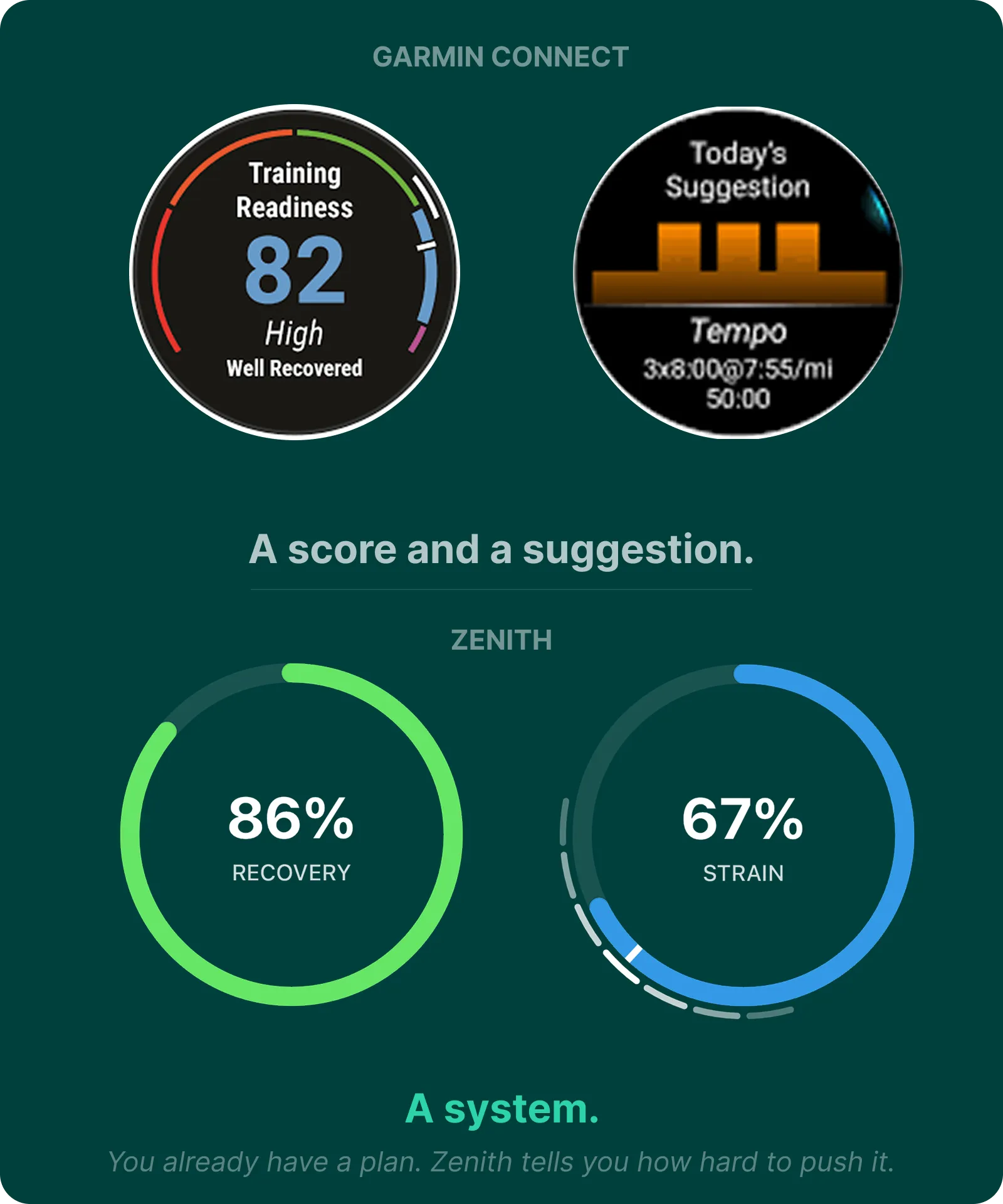
Garmin gives you a Training Readiness number. It’s useful. But when that number drops, you’re left guessing. Was it the bad sleep? The heavy session yesterday? The accumulated fatigue from a tough training block?
A single number doesn’t tell you much if you don’t know what’s behind it. Your HRV, resting heart rate, sleep quality, recent strain, and recovery trends all feed into how your body feels on a given day. The question isn’t what your readiness is. It’s why.
Zenith answers that. When your recovery score drops, Zenith shows you which metrics deviated from your personal baseline and by how much. You don’t have to wonder whether it was the poor sleep or the heavy deadlift session or both. You can just see it. Instead of a number with no explanation, you get the context to actually make a decision about your training.
Sleep: Not Just a Score, but a Target
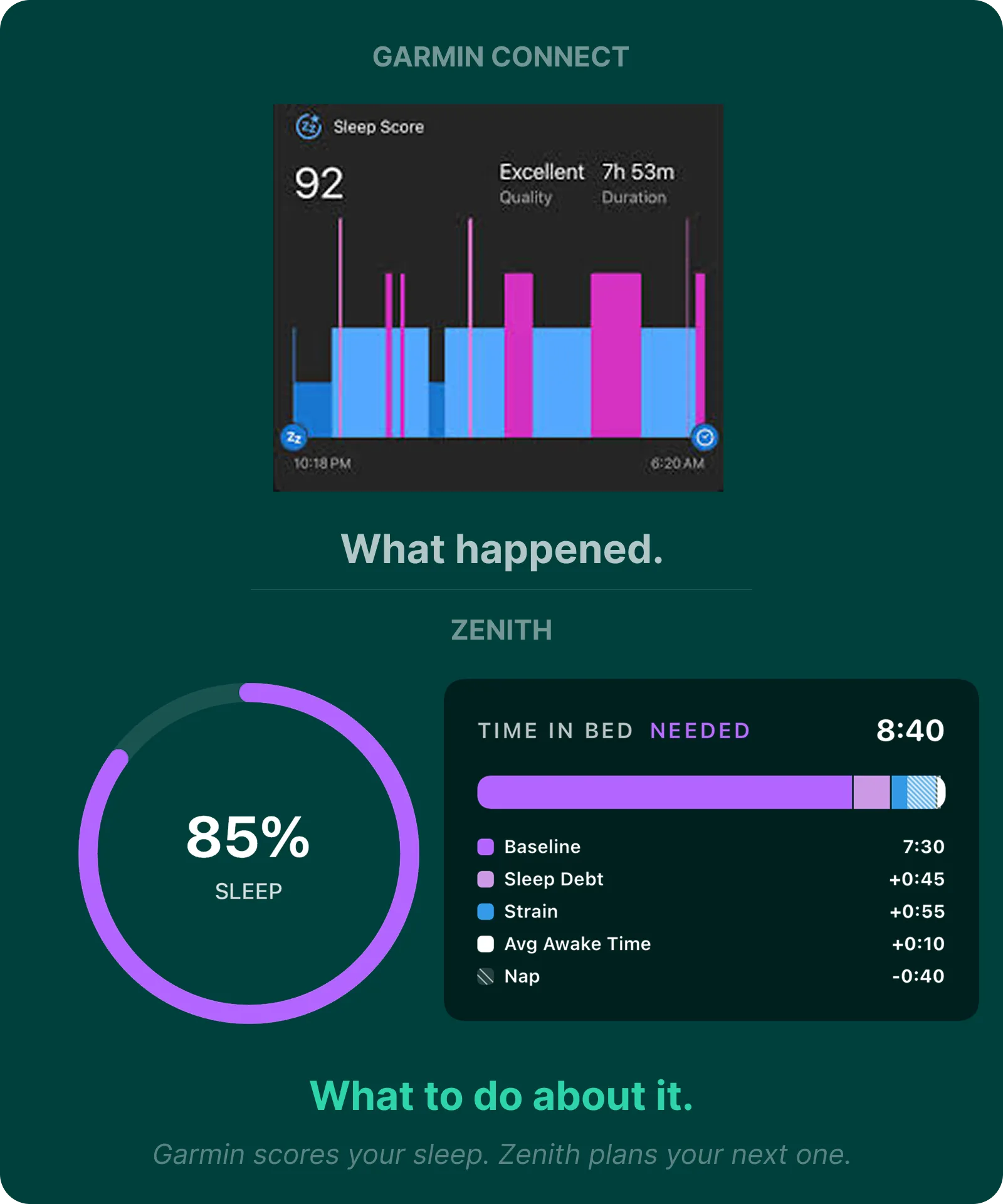
Garmin’s Sleep Score is actually solid. It accounts for duration, sleep stages, restlessness, and SpO2. As a snapshot of how last night went, it does a good job.
Where it falls short is over time. One bad night is very different from five. Sleep debt compounds, and when you stack a string of bad nights on top of high-strain training days, your body pays for it in ways a single night’s score can’t capture. Garmin treats each night as its own report card. It doesn’t track the accumulation.
Zenith does. It calculates how much sleep you need tonight based on accumulated sleep debt, recent strain, average awake time, and naps. Not just a score. A target. If you need 8 hours and 40 minutes, you’ll know before your head hits the pillow.
That compound effect matters. A week of six-hour nights during a heavy training block doesn’t just mean bad sleep scores. It means your recovery drops, your sleep debt climbs, and your recommended strain range tightens. Zenith shows you all of that so you can back off before your body forces you to.
A Recommended Range, Not a Prescribed Workout
Most Garmin users already have structure. They follow training plans, whether self-built, from a coach, or from a program they trust. They don’t need an app telling them to go for a 30-minute easy run. That kind of generic recommendation is close to useless for someone who already knows what they’re doing today.
What they actually need is knowing how hard to push.
Zenith gives you a recommended strain range for the day based on your recovery, recent load, and accumulated fatigue. Think of it as an intensity dial. If you have an 8-mile run on the schedule, Zenith tells you whether to take it easy, push the pace, or cut the distance. Got an hour-long swim? You’ll know whether to treat it as active recovery or go after it.
Your plan stays yours. Zenith tells you how your body feels about it.
What Garmin Does Well
Garmin gets a lot right, and the list is long.
- Sleep Score (0-100) is a quick, useful read on last night
- Body Battery is helpful for pacing your day
- Training Readiness pulls several metrics into one readiness number
- HRV Status tracks heart rate variability trends over time
- Training Status tells you whether you’re productive, peaking, or overreaching
- Maps and navigation with turn-by-turn routing for runners and cyclists
- Edge bike computers are the best on the market
- Connect+ ($6.99/mo) adds AI-powered insights, a performance dashboard, and nutrition tracking
The hardware ecosystem (watches, chest straps, power meters, bike computers, running pods) is best in class. Period. For endurance athletes, Garmin’s software is solid too.
All of these features share one thing: they’re built on cardiovascular data. If your training stays in the cardio lane, that’s fine. But if you also lift, the picture starts to fall apart.
The Relationship
Garmin captures the data. Zenith interprets it.
Garmin watches are exceptional at measuring what your body does. Heart rate, HRV, sleep stages, GPS, activity detection. Zenith takes that same data and adds what Garmin’s software leaves out: strength training load, sleep debt, recovery context, and intensity guidance that works with the training plan you already have.
We’re not competing with Garmin. We’re making their data more useful.
At a Glance
| Feature | Garmin Connect | Zenith + Garmin |
|---|---|---|
| Recovery Score | Training Readiness (premium watches only) | Yes, with context on why it changed |
| Strain Scoring | Training Load (cardio only, EPOC-based) | Unified: aerobic + muscular load combined |
| Strength Training | Logs activity, but siloed from Training Load | Tonnage, muscle heatmaps, 1RM estimates, feeds into strain |
| Sleep | Sleep Score (last night only) | Sleep Score + sleep debt + personalized sleep target |
| Training Guidance | Suggested Workouts (prescribed sessions) | Recommended strain range (intensity guidance for your plan) |
| Community | Daily feed | Leaderboards, friends, social accountability |
| Hardware Required | Garmin watch | Same Garmin watch you already own |
| Cost | Free (Connect+ $6.99/mo) | Free tier available |
Works With Every Garmin
Any Garmin watch that syncs to Garmin Connect works with Zenith. Forerunner, Fenix, Epix, Venu, Instinct, vivoactive, and anything else in the lineup. Connect your Garmin account and Zenith starts pulling your data automatically. No extra setup, no extra hardware.
Who Should Use What
Garmin Connect alone works well if your current metrics give you everything you need. If you’re primarily an endurance athlete and you’re happy with the insights Garmin provides, there’s no reason to change anything.
Zenith + Garmin is for athletes who also lift and want their strength training to actually count toward recovery and strain. A lot of Garmin users already log their lifting with the Strength activity profile. That data just sits in a silo, disconnected from Training Load and recovery. Zenith connects it to the full picture.
Your Garmin already collects the data. Zenith helps you use all of it.
For how Zenith compares to the other Garmin apps, see The Best App for Your Garmin in 2026, and for the wider list of options, the best Garmin Connect alternatives in 2026.
Want to see what your Garmin data is actually telling you? Try Zenith. It’s free to start.