 Zenith Wellness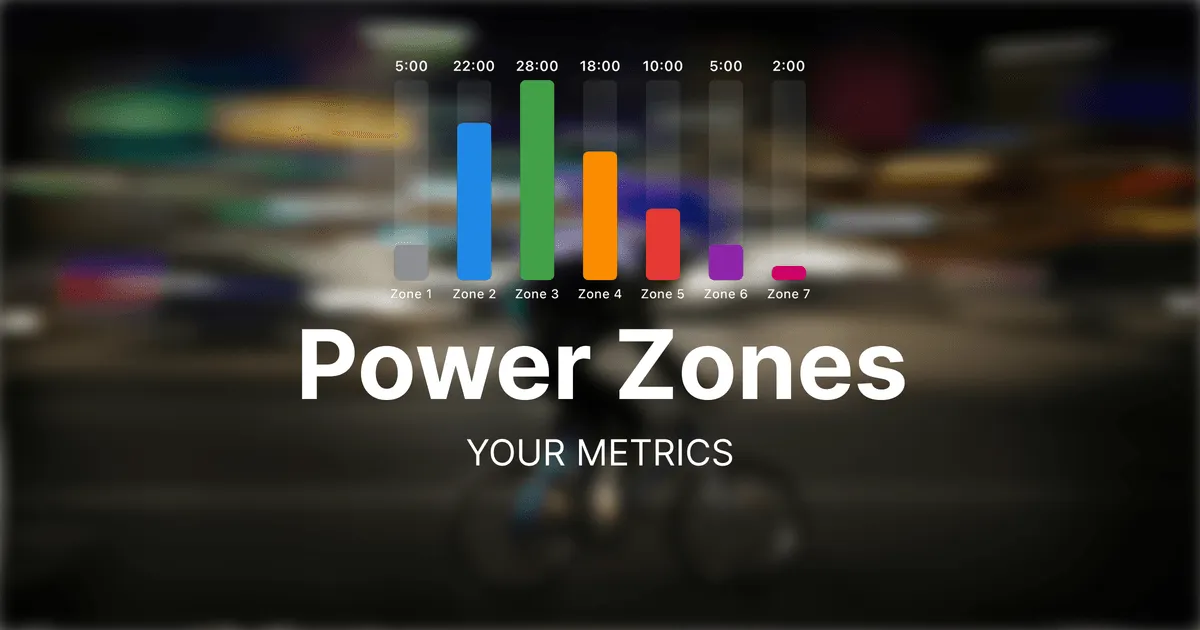
Quick answer: Cycling power zones are seven intensity bands set as percentages of your Functional Threshold Power (FTP). They run from active recovery in zone 1 to maximal sprints in zone 7, and each band drives a specific adaptation. Training by zone lets you target endurance, threshold, or VO2max work with precision instead of guessing at effort.
Power is the most objective measure of cycling intensity. Heart rate lags, drifts with fatigue and temperature, and varies day to day. Power is instantaneous and absolute. If you’re pushing 250 watts, you’re pushing 250 watts regardless of how hot it is or how tired you feel.
That’s why power zones are the standard for structured cycling training. Unlike running, there are no useful speed zones for cycling. Speed on a bike is heavily influenced by gradient, wind resistance, drafting, road surface, and bike setup. You can put out 300 watts going 18 mph uphill and 300 watts going 30 mph on a flat with a tailwind. Same effort, completely different speeds. Power strips all of that away and gives you a single number that reflects how hard you’re actually working.
Functional Threshold Power (FTP)
The maximum power you can sustain for one hour. Developed by Dr. Andrew Coggan and Hunter Allen in Training and Racing with a Power Meter, FTP is the gold standard metric for cycling fitness because power at lactate threshold is the most important physiological determinant of endurance cycling performance.
Your FTP determines your training zones and serves as the primary benchmark for tracking cycling fitness improvements.
Zenith lets you set your FTP manually in settings. If you’ve done a 20-minute FTP test, a ramp test, or you know your number from a lab, enter it directly. Your zones are calculated immediately.
Your Seven Zones
Seven intensity zones from Coggan and Allen based on your FTP. Each zone creates distinct physiological adaptations.
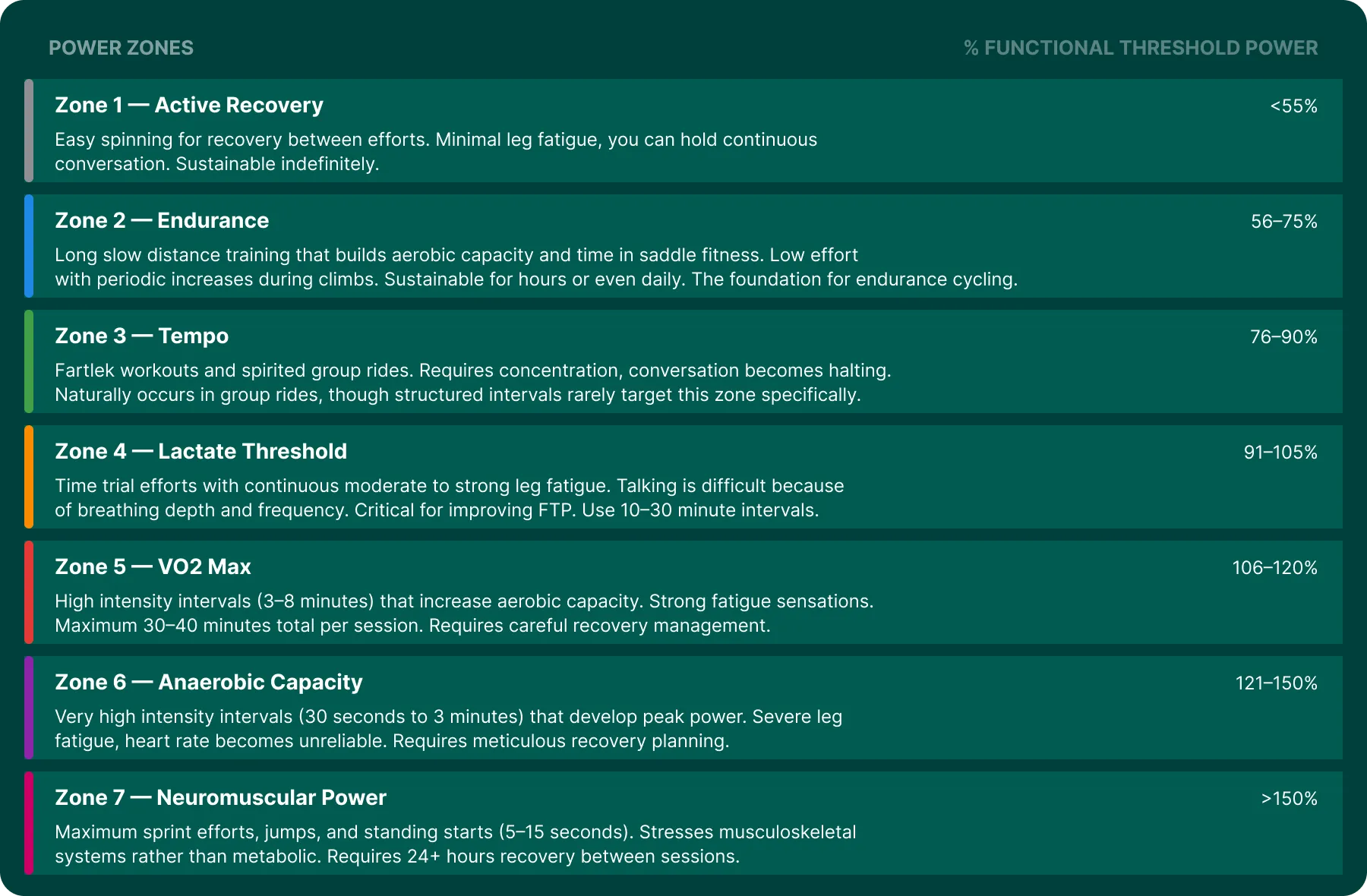
| Zone | Name | % of FTP | What it trains |
|---|---|---|---|
| 1 | Active Recovery | Under 55% | Easy spinning and recovery between hard days |
| 2 | Endurance | 56 to 75% | Aerobic base, the bulk of most riders’ weekly volume |
| 3 | Tempo | 76 to 90% | Steady moderate work and the lower end of sweet spot |
| 4 | Threshold | 91 to 105% | Power at and around FTP, the most productive structured work |
| 5 | VO2max | 106 to 120% | Aerobic ceiling through 3 to 8 minute intervals |
| 6 | Anaerobic | 121 to 150% | Short, very hard efforts for surges and attacks |
| 7 | Neuromuscular | Over 150% | Maximal sprints of 5 to 15 seconds |
As Coggan notes, these are “levels” on a continuum, not discrete switches. Training at specific power zones allows precise control over workout intensity and physiological adaptations.
Power Zones vs Heart Rate Zones
Heart rate is a response. Power is an input. That distinction matters for how you use each one.
Heart rate tells you how your body is responding to the work. It’s affected by heat, caffeine, fatigue, hydration, and cardiac drift over long efforts. Two identical rides can produce different heart rate profiles depending on conditions.
Power tells you exactly how much work you’re doing. It doesn’t drift, doesn’t lag, and doesn’t care about external conditions. When you’re targeting a specific training stimulus, power is the more precise tool.
Where heart rate still matters: recovery assessment. Your heart rate response to a given power output tells you about your fatigue state. If 200 watts normally puts you at 145 bpm and today it’s 160 bpm, you’re carrying fatigue. Zenith shows both heart rate zones and power zones for every cycling activity so you can see this relationship.
Using Power Zones to Train
Easy rides belong in zones 1-2. Recovery spins, coffee rides, and base building. If you’re a road cyclist, this is where the majority of your weekly volume should live. It feels too easy. That’s the point.
Group rides naturally land in zone 3. The pace surges on climbs, eases on descents, and sits at tempo between. This is fine as unstructured riding, but it’s not a substitute for targeted zone 2 or zone 4 work.
Threshold intervals are zone 4. The most productive structured work for time-crunched cyclists. Two to four intervals of 10-20 minutes at FTP, with 5-minute recovery between. Once or twice per week.
VO2max intervals are zone 5. Shorter (3-8 minutes), harder, with equal recovery. These build aerobic ceiling. Use in specific training blocks, not year-round.
Anaerobic work is zone 6. Short, very hard efforts (30 seconds to 3 minutes). Develops the ability to surge, attack, and respond to accelerations. High fatigue cost.
Sprints are zone 7. Maximum neuromuscular efforts lasting 5-15 seconds. These train raw power output and recruitment, not metabolic fitness. Short recovery between reps, but 24+ hours between sprint sessions.
Tracking It
Your Garmin collects power data from your power meter or smart trainer. Zenith maps every second to a power zone and shows the time distribution after each ride. You can see exactly how much time you spent in each zone and whether your structured intervals hit the target.
Want to see your power zones? Try Zenith. It’s free to start.