 Zenith Wellness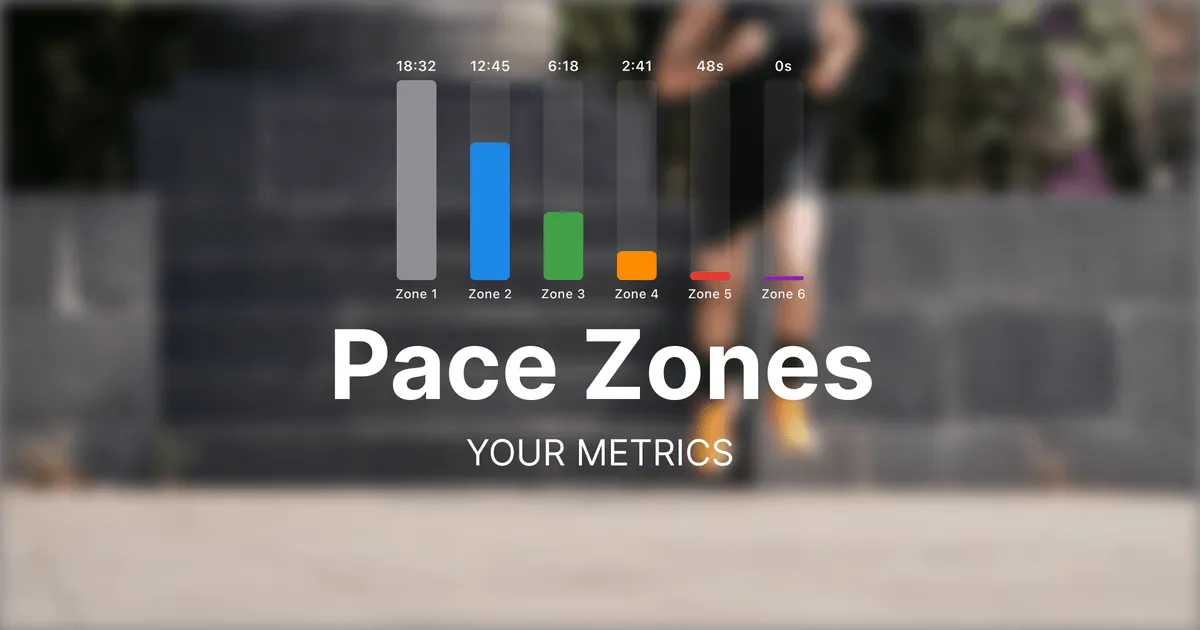
Pace zones are running-specific intensity zones based on your lactate threshold pace: the pace you can sustain for about an hour at maximum effort. These zones guide your training.
Heart rate zones tell you how hard your cardiovascular system is working. Pace zones tell you how fast you’re actually running relative to your fitness. Both matter, but pace zones are more specific to running performance. A heart rate of 155 bpm could mean easy pace on a hot day or tempo pace on a cool one. Pace zones remove the ambiguity.
The Cameron Method
When you set a personal record at one distance, Zenith uses the Cameron method to predict your equivalent performance at other distances and calculate your lactate threshold pace. Developed by Dave Cameron (1999) using world-level athlete data, this model accounts for how running performance scales across different distances.
For example, if you run a 5K in 20 minutes, the formula predicts your marathon time won’t simply scale linearly. Instead, it accounts for the different physiological demands of short versus long distance running to estimate what pace you could sustain for 60 minutes.
This is how Zenith calculates your lactate threshold pace from any personal record you enter, which then determines your personalized pace zones for training.
You can enter a PR at any distance from 1500m through the marathon. Zenith supports all standard race distances. One good race result is all it takes to set your zones.
Your Six Zones
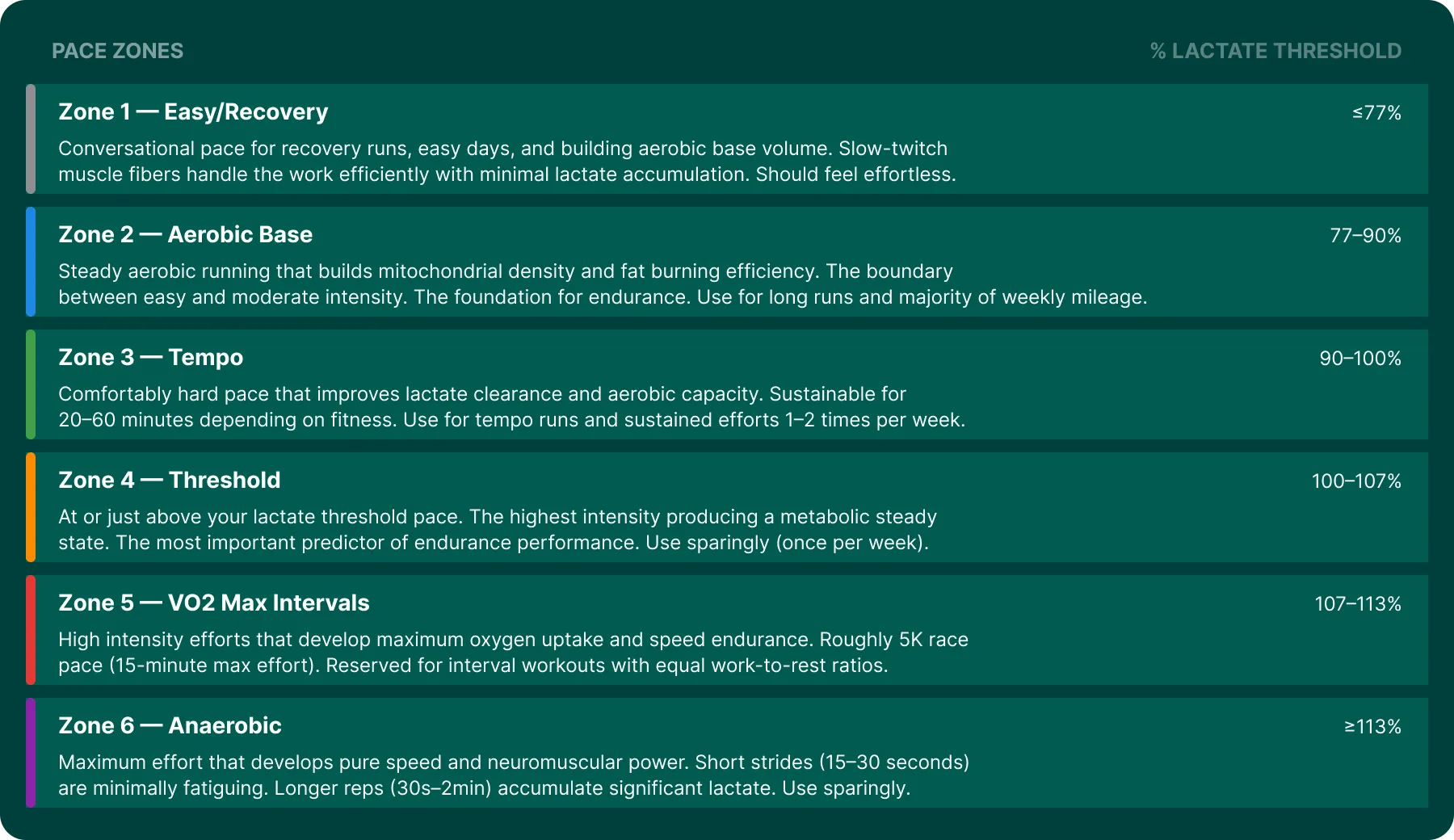
All zones are defined as percentages of your lactate threshold (LT) pace.
How Your Zones Adjust
Your pace zones are anchored to your lactate threshold pace. When you set a new PR, Zenith recalculates your LT and all six zones shift accordingly. A faster 5K doesn’t just mean faster zone 5 work. It means every zone boundary moves up to reflect your improved fitness.
This is different from heart rate zones, which shift gradually as your resting heart rate changes over weeks and months. Pace zones can update immediately after a race or time trial.
Pace Zones vs Heart Rate Zones
Both systems measure intensity, but from different angles.
Heart rate zones reflect cardiovascular effort. They’re affected by temperature, hydration, fatigue, caffeine, and time of day. They tell you how hard your body is working regardless of pace.
Pace zones reflect mechanical output. They tell you how fast you’re running relative to your current fitness. They’re not affected by heat or fatigue in the way heart rate is. They’re a cleaner signal of training intent.
In practice, use both. Pace zones tell you what to target. Heart rate zones tell you what it’s costing your body. If your pace is in zone 2 but your heart rate is in zone 4, something is off: heat, fatigue, dehydration, or under-recovery. That mismatch is useful information.
Zenith shows time in both heart rate zones and pace zones for every running activity.
Using Pace Zones to Train
Running at the right pace for your workout goal maximizes training effectiveness and prevents overtraining.
Easy runs belong in zone 1. This is where most runners go wrong. Easy pace should feel easy. If you can’t hold a conversation, you’re too fast. The aerobic adaptations you’re after happen just as effectively at zone 1 as they do at zone 2, with far less fatigue.
Long runs belong in zones 1-2. The purpose is time on feet and aerobic volume. Drifting into zone 3 late in a long run is common and usually fine, but starting there means you’re working harder than the session calls for.
Tempo runs are zone 3. Sustainable for 20-60 minutes. The goal is to practice holding a comfortably hard pace. One to two sessions per week.
Threshold work is zone 4. Intervals of 8-20 minutes at or just above LT pace, with short recovery. This is the session that most directly improves race performance. Once per week is enough.
VO2max intervals are zone 5. Short, hard efforts (3-5 minutes) with equal rest. Roughly 5K effort. Reserve for specific training blocks.
Speed work is zone 6. Strides, hill sprints, and short repeats. Builds neuromuscular power and running economy. Short strides a few times per week are low cost and high return. Longer zone 6 repeats are taxing and should be used sparingly.
Raw Pace, No Adjustments
Zenith uses your raw pace as recorded by your Garmin. There is no grade adjusted pace (GAP) calculation and no corrections for wind, temperature, or humidity. A 7:30 mile on flat ground and a 7:30 mile uphill will map to the same zone, even though the uphill effort is harder.
This means your zone distribution on hilly routes won’t perfectly reflect perceived effort. If you’re running a mountainous course and your zone breakdown looks easier than it felt, that’s why. For now, use heart rate zones alongside pace zones on hilly or extreme-weather runs to get the full picture.
Tracking It
Your Garmin collects the pace data. Zenith maps every second of your run to a pace zone and shows the time distribution after each activity. Over time, you can see whether your easy runs are actually easy and whether your hard sessions are hitting the right zones.
Want to see your pace zones? Try Zenith. It’s free to start.