 Zenith Wellness
Wearables are good at telling you how you slept last night. A score, a stage breakdown, a duration. What they don’t tell you is how much sleep you actually need tonight, or what happens when you miss that target for several nights in a row.
One bad night is a blip. A string of them changes how your body recovers, how hard you can train, and how you feel doing it. But most apps treat each night as a standalone event, grading what happened without planning what’s next.
Zenith tracks all three: how much sleep you need, how much you got, and the debt you’re carrying.
Sleep Performance
Sleep performance is the primary metric. It runs from 0-100%: hours slept divided by hours needed, capped at 100%. Sleeping longer than your target doesn’t push the score above 100%. Ten hours in bed when you needed eight still reads 100%.
Consistently hitting 100% means you’re meeting your body’s recovery demands night after night. Dropping below it means you’re accumulating debt. The number updates each morning after your sleep data comes in.
Your Sleep Need Is Personal
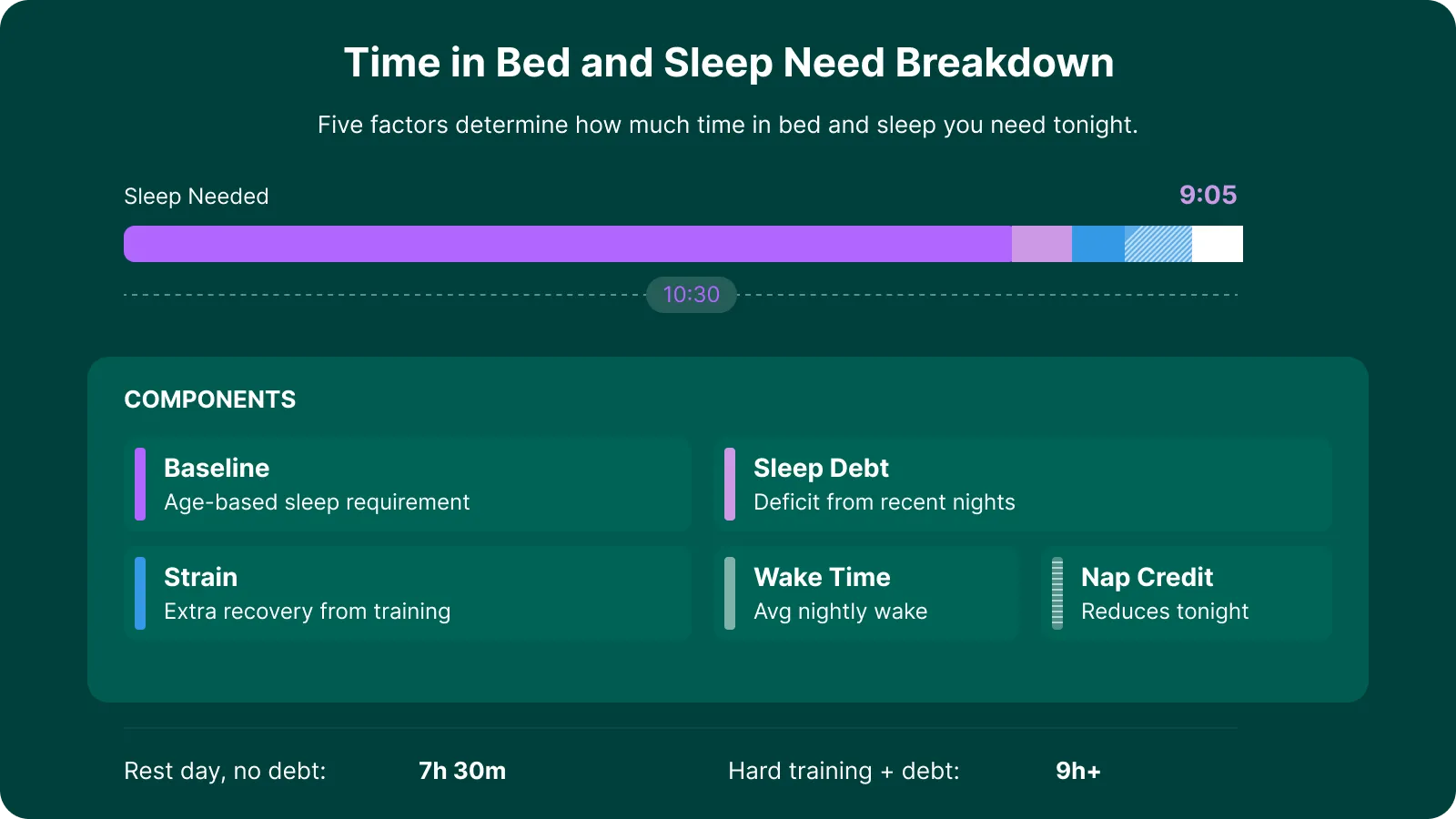
“Eight hours” is a generalization. Sleep need varies by person, by age, and by what you did today. A rest day and a day after heavy squats require different amounts of sleep. A week of accumulated short nights changes the number too. Zenith calculates your personal sleep need from five components.
| Component | What it does |
|---|---|
| Baseline | Your starting point, roughly 7-8 hours for most adults. Steadily declines with age and settles as Zenith learns your patterns. |
| Sleep Debt | Accumulated deficit from recent nights. May not disappear after one good night. Running short for days means your body needs extra sleep to pay it back. |
| Strain | Harder training days demand more recovery time. Both aerobic load from your run and muscular load from your lifting factor in. A rest day and a heavy deadlift day produce meaningfully different sleep needs. |
| Average Wake Time | Time spent awake in bed, whether scrolling your phone before falling asleep or waking briefly during the night. Zenith accounts for this so your total time in bed reflects what you actually need. |
| Nap Credit | A midday nap reduces what you need tonight. If you grabbed 30 minutes after lunch, your evening target adjusts down accordingly. |
These five components add up to a single number: your time in bed target for tonight. It moves every day based on recent training and sleep history.
On a rest day with no sleep debt, you might need 7 hours 30 minutes. After a hard training day with two nights of poor sleep behind you, that number could climb past 9 hours.
Four Stages, Two That Matter Most
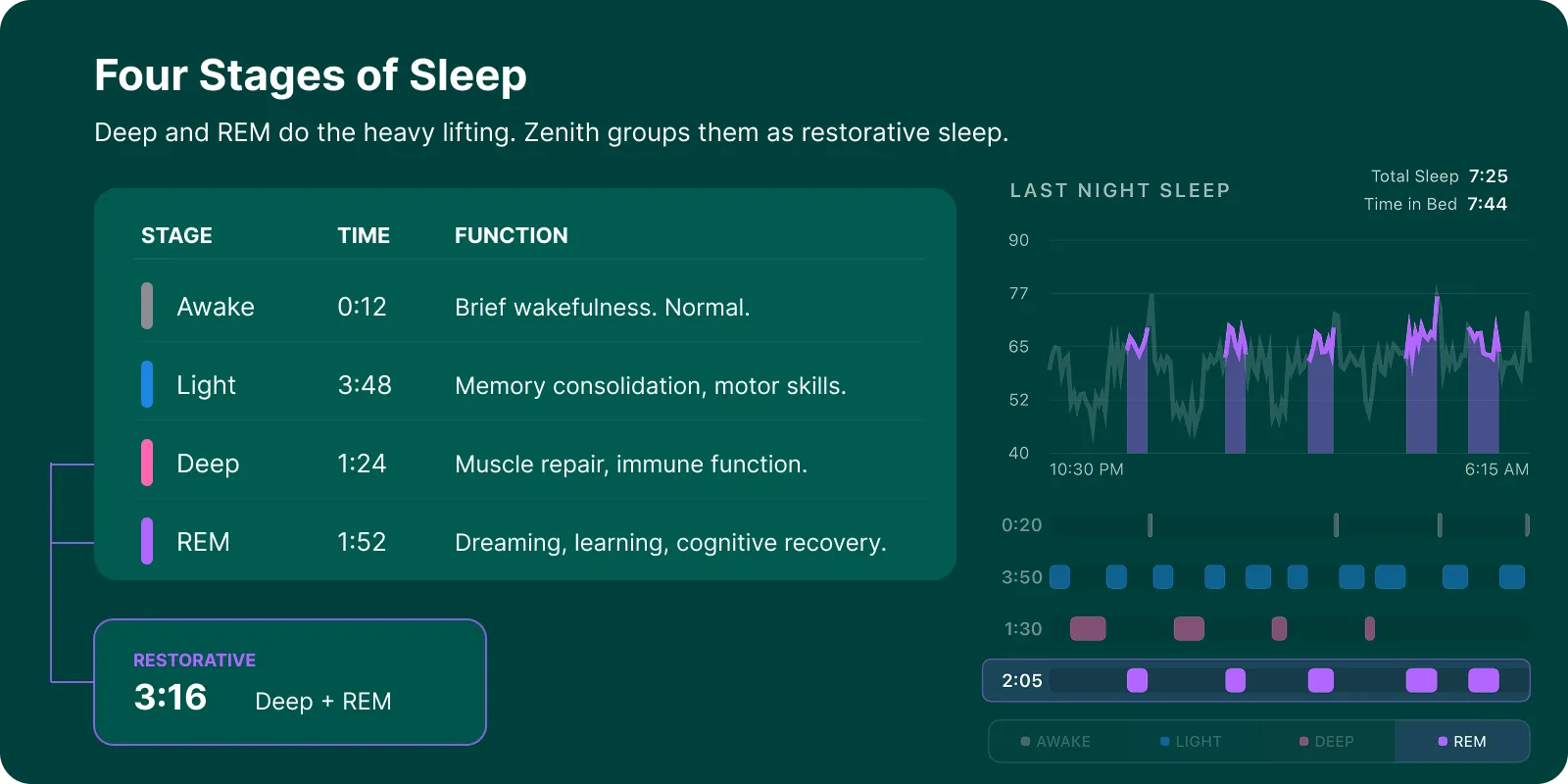
Not all sleep is equal. Your body cycles through four stages throughout the night, each serving a different function. You typically complete four to six full cycles, each lasting roughly 90 minutes.
| Stage | Function |
|---|---|
| Awake | Brief periods of wakefulness during the night. Everyone has them. A few minutes here and there is completely normal and doesn’t mean you slept poorly. |
| Light | The transitional stage where you spend the most time. Memory consolidation and motor skill development happen here. Not wasted time, but not where the heavy recovery work gets done. |
| Deep | Slow-wave sleep. Muscle and tissue repair, immune function, growth hormone release. The stage athletes care about most. Concentrates in the first half of the night. |
| REM | Dreaming, emotional processing, memory consolidation, and learning. Critical for cognitive recovery. REM periods get longer as the night goes on. |
Zenith groups deep and REM together as restorative sleep. These two stages account for the majority of physical and mental recovery. Light sleep and brief awakenings are normal parts of the night, but deep and REM are where the most meaningful recovery happens.
Sleep Efficiency and Sleep Debt
Two related concepts that round out the picture. One measures the quality of a single night. The other measures the cost of many.
Sleep efficiency is the ratio of time asleep to time in bed. If you’re in bed for 8 hours but only asleep for 7, that’s 87.5% efficiency. High efficiency means you’re falling asleep quickly and staying asleep. Low efficiency means you’re lying awake, tossing, or waking up repeatedly. The number tells you whether your time in bed is being well spent.
Sleep debt is the concept most wearables miss entirely. Most apps treat each night as its own event, but Zenith tracks the accumulation. One short night is recoverable, but several in a row creates a compounding deficit. A string of six-hour nights during a hard training block gradually erodes recovery even if each individual night felt adequate. Your HRV starts to drift, your resting heart rate creeps up, and your recovery score declines. By the time you feel the fatigue, you’ve typically been carrying the debt for days.
Sleep Feeds Recovery
Sleep performance is one of six factors in your recovery score. Miss your sleep need and recovery drops. Recovery sets your recommended strain range. The loop is straightforward: train, sleep enough to recover, repeat.
Want to see your sleep score? Try Zenith. It’s free to start.