 Zenith Wellness
The American Heart Association defines a normal resting heart rate as 60-100 bpm. That range is so broad it’s not useful. A RHR of 62 and a RHR of 95 are both “normal,” but they reflect very different levels of cardiovascular fitness.
What the Risk Data Says
A meta-analysis of 46 studies covering 1.2 million participants found that every 10 bpm increase in resting heart rate is associated with a 9% increase in all-cause mortality. The relationship is linear starting from about 45 bpm. Lower is better, with no floor.
| RHR | What it means |
|---|---|
| <60 bpm | Lowest mortality risk. Common in trained individuals. |
| 60-70 bpm | Normal. Near population median for both sexes. |
| 70-80 bpm | Above median for men. Risk begins rising. |
| >80 bpm | Associated with ~45% higher all-cause mortality vs. the lowest category. |
By Age and Sex
The most widely used fitness classification comes from the YMCA’s fitness testing program, based on approximately 20,000 participants. Your Garmin doesn’t show you this. It just gives you a number.
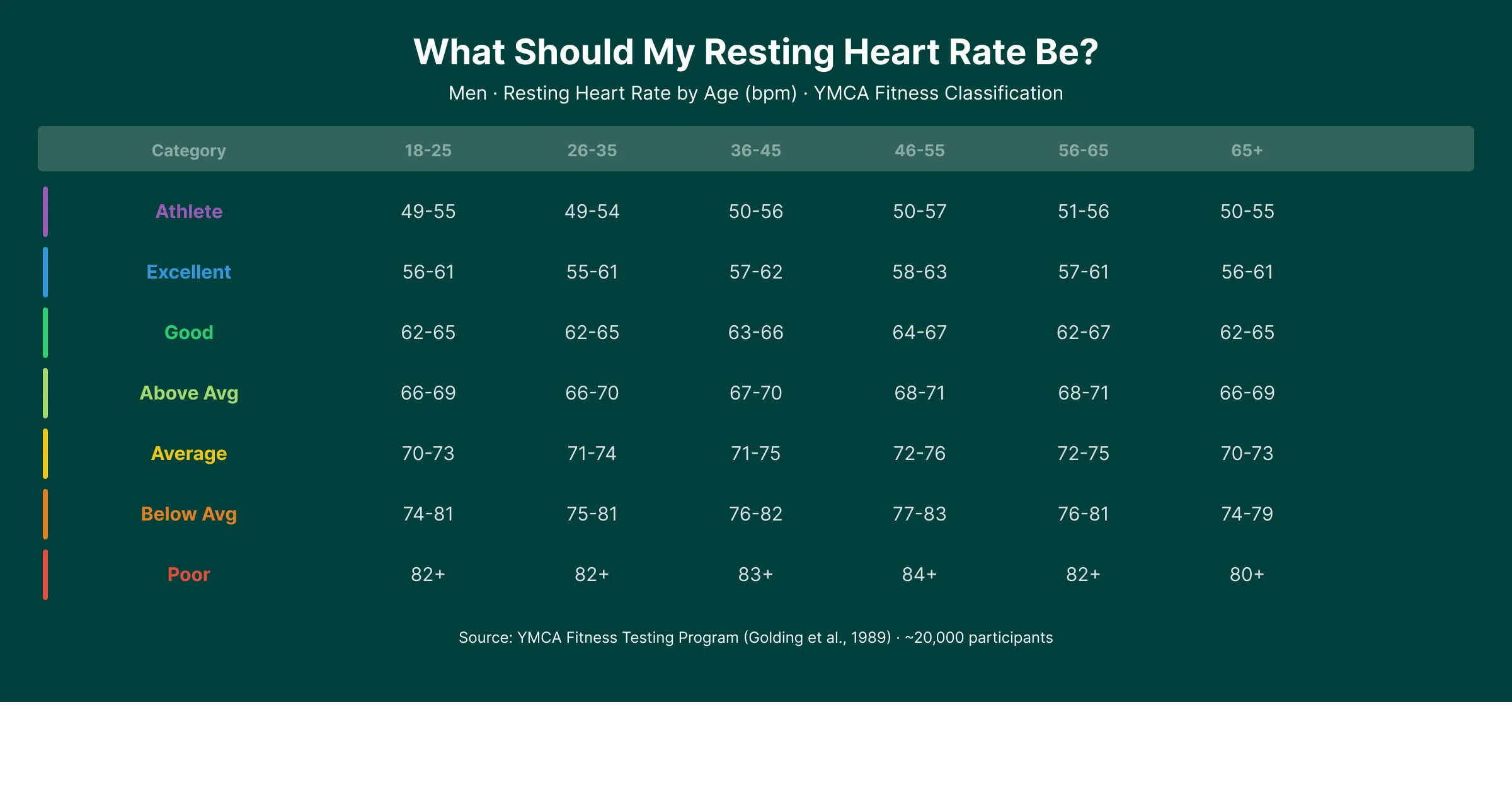
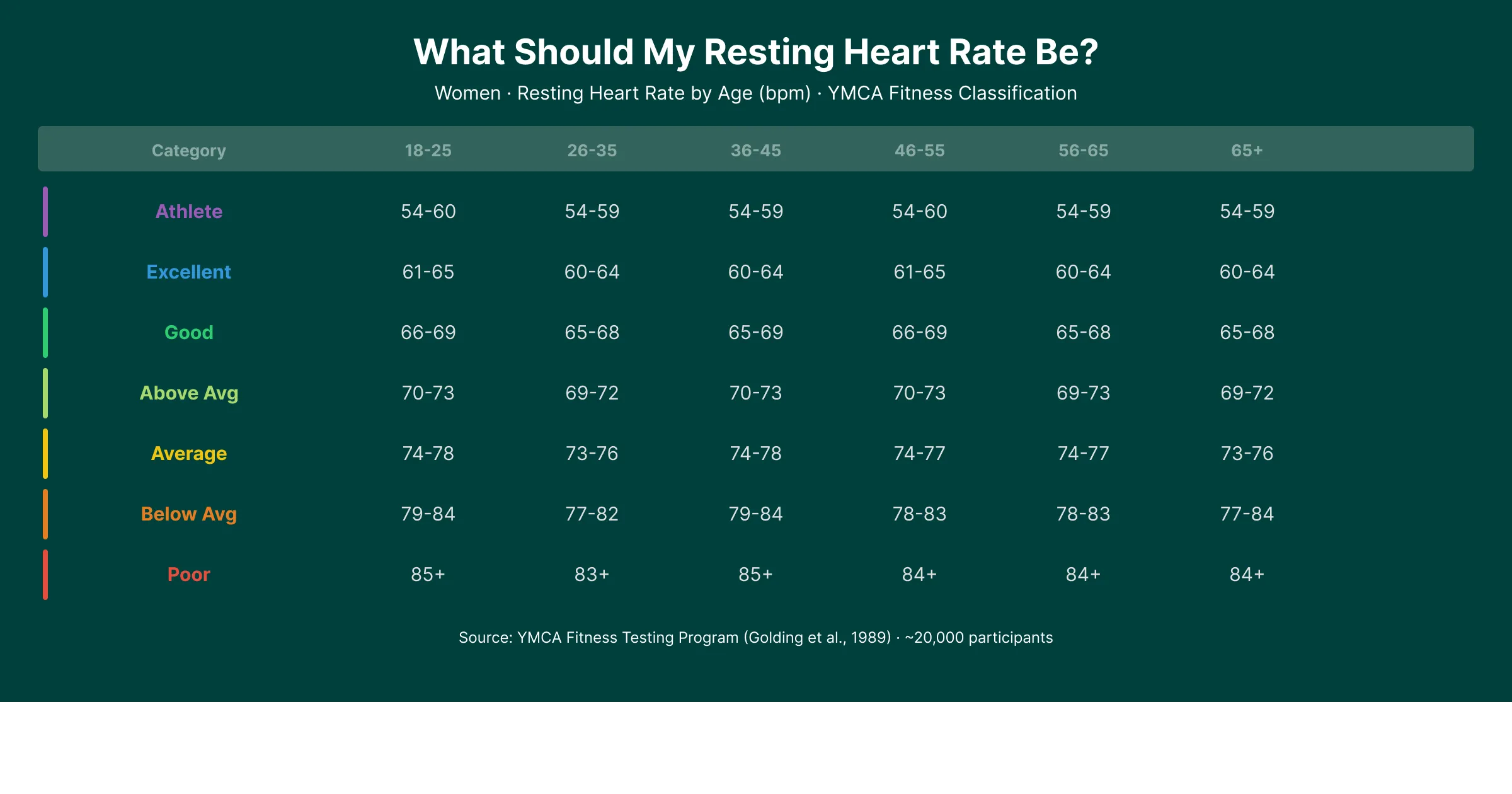
These are from seated clinical measurements. If you’re reading from a wearable overnight, expect 5-10 bpm lower.
Your Trend Matters More
Two equally fit people can have meaningfully different resting heart rates. Genetics, age, medication, and body composition all play a role.
What matters more than any single reading is your trend over time. A declining 30-day average reflects real cardiovascular adaptation. A rising trend can signal overtraining, poor sleep, or accumulated stress. Your RHR compared to your own baseline from three months ago is more useful than comparing it to someone else’s.
Athletes
Endurance athletes commonly sit in the low 40s or high 30s. A meta-analysis of 191 studies found that endurance training reduces RHR by 5-8 bpm on average. Years of high-volume training compound that further.
Bradycardia (below 60 bpm) is the norm in trained athletes, not a concern. It only warrants attention if accompanied by dizziness, fatigue, or fainting.
The Short Answer
If your resting heart rate is in the 50s or low 60s, you’re doing well. If it’s in the 70s, you’re normal but have room to improve. If it’s consistently above 80, it’s worth paying attention to.
The most effective ways to bring it down are consistent cardiovascular training, adequate sleep, and reducing alcohol and nicotine. We cover all of these in How to Lower Your Resting Heart Rate.
Tracking It
Your Garmin already measures resting heart rate during sleep. Zenith folds that into your recovery score alongside HRV, sleep quality, respiratory rate, and recent strain. The trend view shows your 30-day and 90-day averages so you can see the signal through the noise.
Want to see where your resting heart rate sits? Try Zenith. It’s free to start.