 Zenith Wellness
Your resting heart rate reflects how efficiently your heart pumps blood at rest. A stronger heart pushes more blood per beat, so it needs fewer beats per minute. That’s the entire mechanism: cardiac efficiency.
RHR is also a reflection of your autonomic nervous system, the balance between sympathetic (“fight or flight”) and parasympathetic (“rest and digest”) activity. Training improves the structural side. Lifestyle habits influence the autonomic side. Both matter, and both are things you can control.
Not sure what a good resting heart rate is? We break down the population data and what it means in What Should My Resting Heart Rate Be.
Fitness
Training drives the structural cardiac adaptations that lower RHR over months and years.
Cardiovascular training is the most direct lever. A meta-analysis of 191 studies found endurance training reduces RHR by 5-8 bpm on average. Whether that’s easy aerobic volume or shorter high-intensity sessions depends on your starting point and schedule. Both work. Consistency over months matters more than any specific protocol. Three or more sessions per week is where most people see their trend move.
Yoga reduced RHR by ~6.6 bpm in the same meta-analysis. It was one of only two exercise types (alongside endurance training) that significantly lowered RHR in both men and women. The mechanism is likely a mix of cardiovascular and autonomic effects.
Strength training has mixed direct evidence for RHR, but contributes indirectly through body composition. One study found a 12% RHR reduction from weight loss alone.
Overtraining does the opposite. Non-functional overreaching elevates sleeping heart rate by ~5 bpm even when you feel fine in the morning. If your trend is climbing despite consistent work, you need more recovery, not more volume.
Wellness
RHR is measured overnight, so what you do in the hours before bed directly affects the number you see in the morning.
Sleep. Chronically short sleep shifts your autonomic nervous system toward sympathetic dominance. A 2025 systematic review confirmed this reliably reduces parasympathetic HRV markers. If your RHR isn’t trending down despite training, sleep duration is the first thing to audit.
Eating before bed. Digestion elevates core temperature and sympathetic activity. A Northwestern study found that stopping eating 3+ hours before bed reduced nighttime heart rate by 5% over 7.5 weeks, with no calorie change.
Caffeine. Half-life is 5-6 hours. 400 mg within 12 hours of bed disrupts sleep architecture. Even 6 hours out, it reduced total sleep by over an hour. Morning coffee is fine. Afternoon coffee depends on dose and sensitivity.
Nicotine. This applies to all forms: cigarettes, vaping, pouches, snus. Vaping raises RHR ~4 bpm with a marked shift toward sympathetic dominance. Quitting smoking drops RHR 5-15 bpm within a day. If you use nicotine, it’s likely the single largest lifestyle factor elevating your RHR.
Alcohol. ~3 bpm overnight increase on average, dose-dependent. Two or more drinks raise it meaningfully. One drink has little effect. Normalizes quickly after stopping.
Hydration and stress both affect RHR. Dehydration reduces blood volume, forcing a faster heart rate. Chronic stress sustains sympathetic activation. Neither is complicated, just easy to overlook.
These Don’t Stack the Way You’d Think
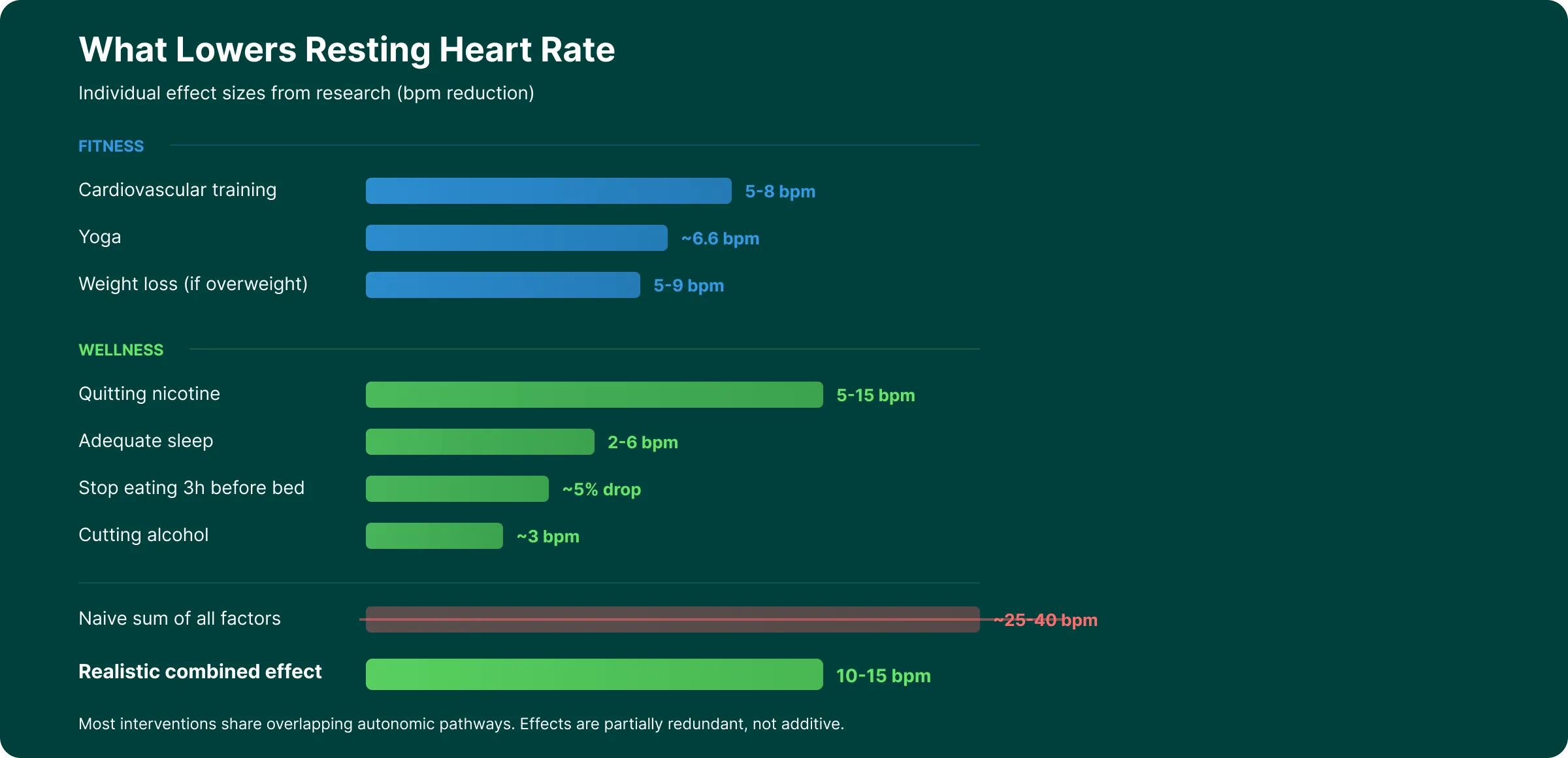
If you add up every number in this article, you’d expect a 25-40 bpm drop from doing everything at once. That’s not how it works.
The LOOK AHEAD trial, one of the largest lifestyle intervention studies ever conducted, combined diet and exercise in overweight adults and found a net RHR difference of about 5 bpm after one year.
Realistically: 10-15 bpm from a comprehensive overhaul starting from an unhealthy baseline. 3-5 bpm if you’re already active and healthy. The further your RHR has already dropped, the harder each additional beat becomes.
How Long It Takes
- 2-4 weeks for noise to settle. Early drops are adjustment, not adaptation.
- 2-3 months for a real trend. 5-8 bpm is typical at 3 sessions per week.
- 6-12 months for larger shifts (e.g., 65 to 55 bpm).
- Years to reach elite levels. Low 40s reflects years of high-volume training.
Day-to-day fluctuations of 5-10 bpm are normal. The signal is in the 30-day and 90-day trend, not any single morning.
Tracking It
Your Garmin already measures resting heart rate during sleep. Zenith folds that into your recovery score alongside HRV, sleep quality, respiratory rate, and recent strain.
When you see that 30-day average quietly ticking down by a beat or two, you’re looking at your heart getting measurably stronger.
Want to track your resting heart rate trend? Try Zenith. It’s free to start.