 Zenith Wellness
The story of how I accidentally became an ultra-runner and how ordinary actions built the life I once considered to be impossible.
By Laura K. Soerensen
In September of 2023, I ran my first half-marathon, averaging a pace of 5 minutes and 5 seconds per kilometre, combined with an average heart rate of 173 beats per minute. It was the furthest distance I had ever run, and by the time I crossed the finish line, I felt completely empty. There was no way I could’ve made it as much as another metre; I was incredibly proud of myself.
Last week, I returned to run the same race once again. This time, I averaged 4 minutes and 34 seconds per kilometre—31 seconds faster for every single kilometre. I had run the race at the end of a large training week as a part of my preparation for the Ironman World Championships next month, yet I finished feeling good enough to complete a two-hour interval session on the bike later that very same day. My average heart rate was actually slightly higher, sitting at 176 beats per minute, but since my body had become capable at absorbing considerably more work, it did not feel as difficult as the first time—what once emptied my tank did no longer represent the limit of my day.
Between those two finish lines, three years passed and I became what most people would describe as an endurance athlete without as much as a second thought. I ran ultramarathons in all types of conditions, completed three ironman races, won my age group at one and climbed mountains around the world. What’s weird, and the part that gets me pondering, is that I cannot confidently identify the precise moment I started feeling like an athlete.
There was never a cinematic breakthrough, nobody handed me a new identity at the finish line of a particular race, I did not wake up one morning with more confidence, capability or discipline than I had possessed the day prior—but I had always kept moving.
Back in 2023, I always assumed that people attempted difficult things because they already viewed themselves as capable. My experience in the past three years has taught me the exact opposite; identity rarely gives us the permission to act. More often than not, it is the repeated actions of doing something hard that gives us the evidence from which a new identity is built.
My first runs were unathletic
Especially in the modern, globalized world, it has become so easy to look at another person’s current training and assume that they must have always been that person. But my sessions in early 2023 looked nothing like the ones I complete today. They lasted exactly 20 minutes—all of them—and consisted of alternating between one minute of running and one minute of walking. There was absolutely nothing dramatic about them. Run, walk, repeat. Run, walk, repeat. Run, walk, repeat until eventually I saw the clock on the treadmill reach 20 minutes. They were neither far nor fast and they certainly did not make me feel qualified to call myself a runner.
The distinction felt important to me back then. The term ‘runner’ seemed like a title reserved for the people who already knew what they were doing. The people who ran continuously, not just for 60 seconds. The people who owned the right equipment, and the people who did not need a walking break every minute.
I had completely misunderstood how identities are formed. I believed I needed to be a runner before I could train like one, when in reality, the training was the very process through which that identity would be created. If you run, you’re a runner. The first actions had to come before the confidence. It had to come before the fitness, the results and the sense that I belonged.
One minute to 50 kilometres
Later that same year, in November of 2023, I ran 50 kilometres. I averaged 6 minutes and 19 seconds per kilometre with an average heart rate of 156 beats per minute. On paper this activity creates a clear and ordered transition; I began with one minute run-walk intervals and became an ultrarunner within the same year. Living through it felt far less organised.
There was never a specific session where everything changed. One-minute intervals simply became longer intervals on a random Wednesday where I felt like pushing myself and realised, ‘hey, maybe I can actually run for two minutes.’ Running continuously stopped feeling like an impossible task and the short runs became normal enough to attempt longer ones. Each distance I completed provided me with the reassurance that the next distance I attempt might be survivable too.
Eventually the 50-kilometre mark moved from being something other people did to being something I was preparing for myself to do, but even as I crossed the finish line, the question of identity did not immediately settle. Sure, I was technically an ultrarunner but emotionally the word still felt far too large for how I viewed myself. The gap between evidence and identity is an important one; our actions can begin changing who we are long before our self-perception catches up. Truly, each one of us may already be building a new life while continuing to describe ourselves using an outdated version of who we used to be.
Progress never announces itself
People like stories with a clear turning point; they’re easier to understand. The reality however is that most of the training that changed me produced no medal, photograph or story worth sharing. This is partly why progress can be so difficult to recognise while it is happening. One run is rarely enough to change anything. One week won’t change much either. Improvement occurs slowly enough for the person experiencing it to remain focused on everything they still cannot do. Then months, or perhaps even years later they return to the same distance and discover that their definition of difficult has changed greatly. This is what happened when I returned to Copenhagen Half Marathon this year.
The course was similar; the distance was still 21.1 kilometres and even the cardiovascular effort looks similar when reduced to an average heart rate—but the two performances represented vastly different levels of capacity.
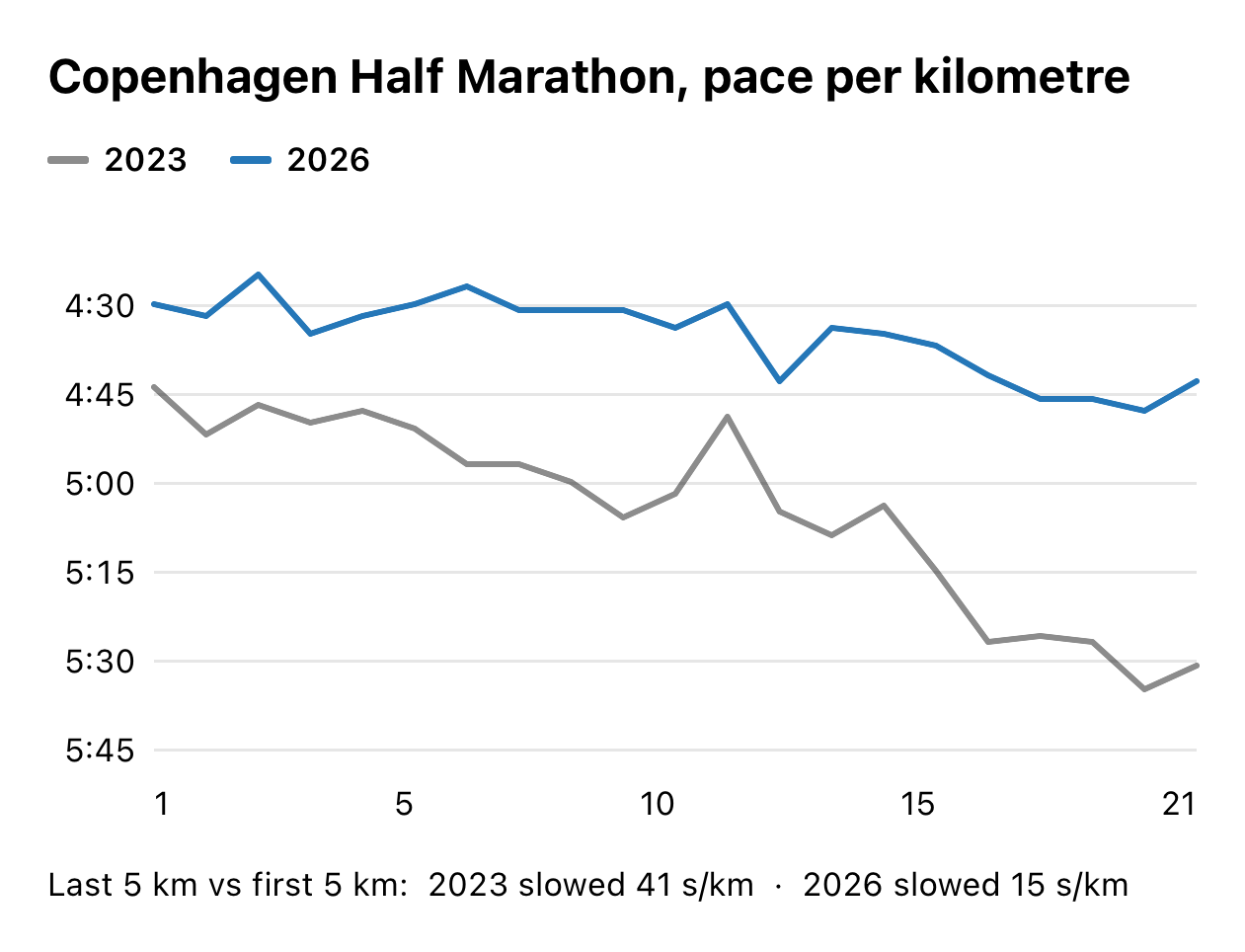
The most striking difference is not the 31 seconds per kilometre, but rather what the performance cost me. In 2023, 21.1 kilometres represented everything I had available. In 2026 I had enough capacity to complete another serious training session just a few hours later. This does not mean that the first performance is less impressive; in many ways it created the second one.
My training volume tells a similar story, though on a larger scale. In October of 2023, I trained for 34 hours. That increased to 40 hours in November and then dropped to 27 hours in December. A few years later, and these numbers look very different.
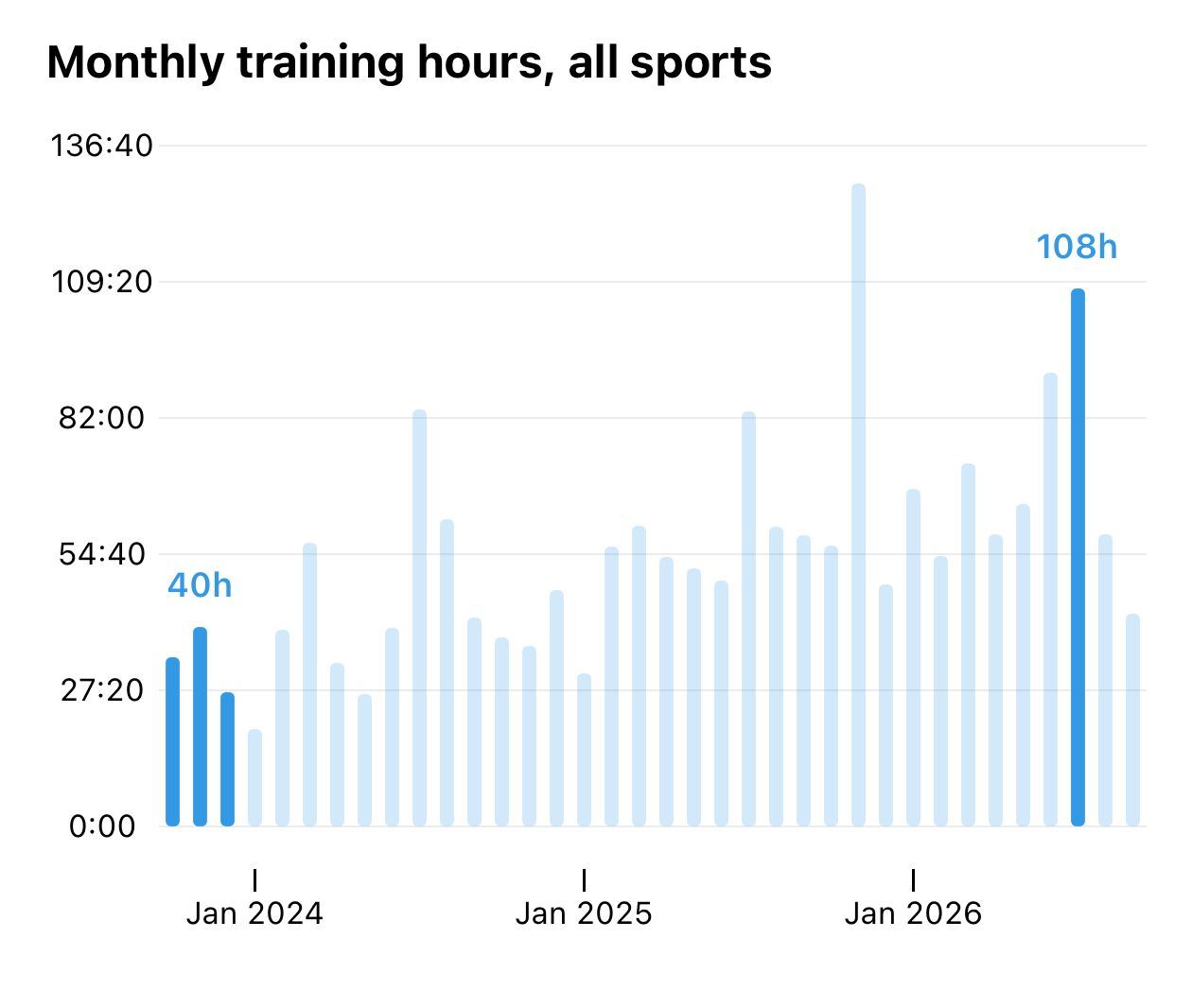
In July of 2026 my body absorbed more than three times as many training hours as December 2023. But I did not jump straight from 27 hours to 108. My body, and the rest of my life, gradually adapted to the workload that would have once been unrealistic, in large part without me even noticing. This data does not reveal a secret workout or sudden breakthrough; it reveals accumulation. Most importantly, someone at the beginning of their journey should not attempt to imitate my current training volume. My present workload is a result of years of adaption, and it exists alongside circumstances and goals that are unique to me. Comparing your first month to my current one would entirely miss the point. The useful comparison is between what I could sustain then and what I can sustain now.
Identity follows evidence
At some point, I stopped describing myself as someone who was ‘trying to get into running.’ Instead, I called myself a runner. Then, I became an ultrarunner. Then later a triathlete, an ironman athlete and even later a mountaineer. None of these identities existed before the actions supporting them. I did not begin swimming, cycling or running because I had magically discovered that being a triathlete was who I was meant to be. The process just became self-reinforcing. For each completed session it became slightly harder to claim that I was not a runner.
Readiness is a result of beginning
Too many people wait to feel ready before they start. They want to become fitter before joining the run club, more confident before getting that gym membership or maybe even faster before allowing themselves to take up space in a race.
However, readiness is not always a condition that is required before one can begin. You gain the confidence by surviving situations that once intimidated you. This does not mean that everyone needs to run an ultramarathon, complete an ironman or climb a mountain. Extreme endurance became a part of my particular story but is not the universal definition of being an athlete. The scale of your personal goal matters way less than the relationships between your actions and building the identity you once believed to be reserved for someone else. Elite performance has never been a requirement to allow movement to become a part of who you are.
My present does not judge your beginning
Today, someone might look at my training and conclude that we are fundamentally different people, and that’s that. They might see the Ironmans, the ultras, the mountains and the monthly training hours without seeing the 20-minute sessions that built it all. This is the danger of meeting someone in the middle of their story. Their current ability may look like characteristics rather than the results of thousands of previous choices. If you compare your first week with my current one this story becomes discouraging. You will just see the distance between us rather than the years contained inside of it. The useful comparison is not between you and me—it is between the action you took yesterday and the one you are willing to take today. Today’s session does not resemble your potential.
Impossible is a temporary description
I remain proud of the 1:49 half marathon I ran in 2023; not because of the time but because that girl created the girl that can now do it twenty minutes faster. Neither performance exists without the 20-minute run-walk sessions that came before them and neither exists without the ordinary training days that feel far too insignificant to be remembered. No individual session explains the transformation, yet the transformation could not have happened without any of them.
I did not start because I was an ultrarunner, an Ironman athlete or a mountaineer. I became those things because I ran, cycled, swam and climbed repeatedly, far before I felt qualified to use any of these names to describe myself. Identity did not lead the actions; it followed them. You do not have to become an athlete before you begin, beginning is how the athlete is built.
Impossible is not always a permanent verdict; sometimes it is simply a description that exists before you have accumulated enough evidence to change it.